
A protective relay or tariff energy meter is only as reliable as the reference standards used to calibrate it. Without unbroken traceability to national physical standards, calibration certificates are merely formal paperwork rather than engineering guarantees.
The Chain of Metrological Traceability
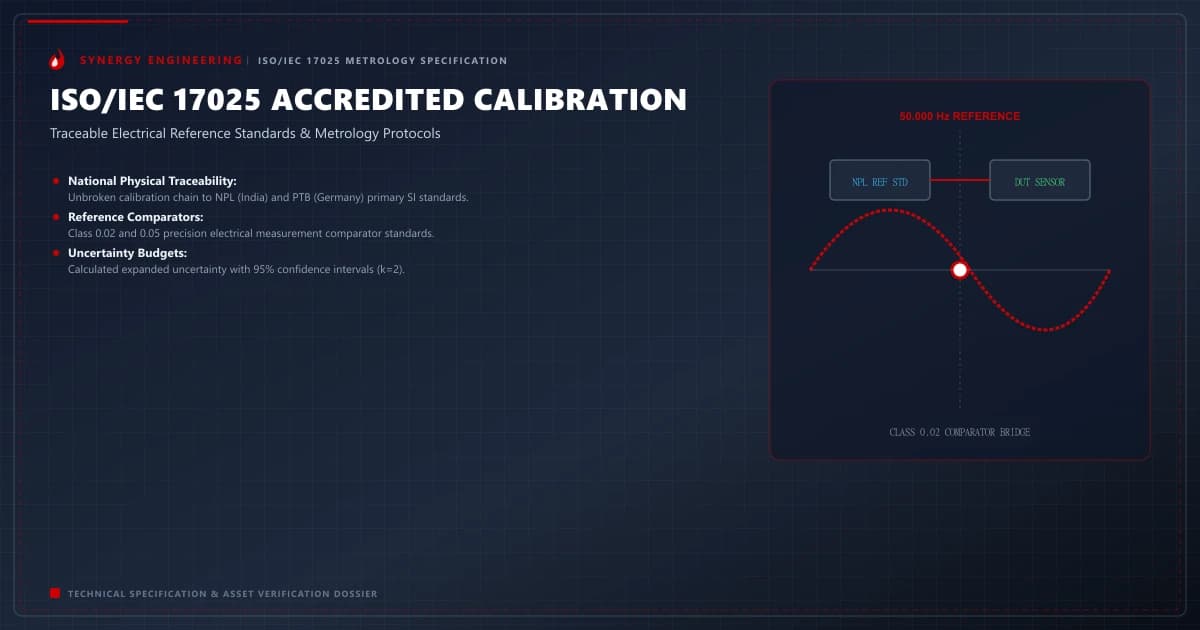
Metrological traceability requires an unbroken chain of comparisons, each with stated measurement uncertainties, linking field test kits back to primary SI standards held by institutes such as NPL (National Physical Laboratory, India) and PTB (Germany).
Under ISO/IEC 17025:2017 accreditation, Synergy Engineering maintains high-precision class 0.02 and 0.05 comparator standards. Every calibration certificate generated includes calculated expanded uncertainty budgets with a 95% confidence interval (k=2).
“"In high-voltage relay testing, an unverified 0.5% drift in current measurement can mean the difference between tripping a single feeder or destabilizing an entire regional substation busbar."
Metrology & Calibration Division
On-Site Calibration vs. Laboratory Calibration
While controlled environmental conditions (23°C ± 1°C, 50% ± 10% RH) in stationary laboratories provide minimum uncertainty for high-end reference meters, modern industrial operations require fast turnaround. Synergy operates mobile calibration units equipped with portable calibrators and isolation transformers, bringing ISO/IEC 17025 accredited procedures directly into client switchyards and control rooms.
Discussions (0)
Loading discussion...